Regeneration
West Kowloon Cultural District
White elephant or a new model for development in Hong Kong? Christopher DeWolf takes a look at the ups and downs of the $1.8bn waterfront project



Last November, thousands of people thronged the Hong Kong waterfront for a festival with an unusual name: Freespace. Young people sold handicrafts and second-hand clothes along a seafront promenade, while families picnicked on the grass and food vendors made brisk business hawking pizza and beer. At one point, a group of people dressed in giant seagull costumes wandered through the crowd, papier-mâché beaks pecking at the ground.
Freespace’s focus is revealed in its name. In a city where public parks are governed by many onerous restrictions – no dog-walking, frisbee-throwing or music-playing allowed – the festival was conceived as a way to see what would happen if Hongkongers used a park as they liked. It could set an important precedent. Over the next few years, the festival’s waterfront site will be transformed into the West Kowloon Cultural District, a £1.8bn, 40 hectare collection of museums, theatres, shops, flats and public spaces.
More than just a cultural district, West Kowloon is an ambitious experiment in architecture and urban planning. Built on a piece of land reclaimed from the sea in the early 1990s, it could set a new model for development in Hong Kong, where profits usually trump good architecture and planning. But spiralling costs and delays have taken their toll on the project’s reputation, with one local newspaper decrying it as “one of the ugliest breeds of white elephant.” Delays on an adjacent train terminus mean that construction on most of the project won’t be finished until the late 2020s.
“I think it will be very difficult,” says John Batten, an art and architecture critic who has followed West Kowloon’s development. “Hong Kong doesn’t do public space very well.”
Such scepticism could be forgiven, considering the district’s history. When the project was first announced by the Hong Kong government in 2003, it was conceived primarily as a tourist attraction, with exclusive development rights given to one of Hong Kong’s largest property conglomerates. Foster + Partners proposed a design that enclosed the entire district under an enormous canopy.
The public was not impressed. Eventually, the entire scheme was sent back to the drawing board, with the developer replaced by an independent government agency, the West Kowloon Cultural District Authority. That led to a new public competition for its masterplan, with a shortlist that included avant-garde proposals from Rem Koolhaas’ OMA and local architect Rocco Yim. In the end, the public chose yet another plan from Norman Foster, this time based around a grid of pedestrian-only streets running from the dense, older neighbourhoods of Kowloon to a large new park on the site’s western edge.
“We approached West Kowloon with a new idea of the cultural district being an extension of the city, influenced heavily by the DNA of its streets, alleyways and building blocks,” says Foster. That started with the recognition that “exemplar cultural districts can be, if you’re not careful, terrible urban districts,” says Colin Ward, Foster’s Hong Kong-based partner. “The question we asked ourselves is, how do we make this an extension of the city, but better?”
Foster says the masterplan relies on a mix of “anonymous city architecture” with a few landmark structures. “We would advocate that, as the architecture is developed, there are a limited number of 'star' buildings within the context of more general background buildings and urban spaces, like streets, squares and parks,” he says. “Public space is the urban glue that binds the city together, and will be central to the success of the new district.”
ACHILLES HEEL?
The key to that approach is to banish all vehicular traffic underground, in a system of subterranean roadways and service entrances. That will free up the entire ground plane for pedestrians and cyclists – a bold statement at a time when Hong Kong’s traffic congestion and air pollution continue to worsen. It may also be the plan’s Achilles’ heel, adding serious cost and technical complexity to the project. Last year, some Hong Kong lawmakers urged the government to scrap the underground portion of the plan, which it has so far resisted. To make matters worse, construction of the basement cannot begin until the completion of the adjacent high-speed railway terminus, which is running several years behind schedule.
That means Foster’s anonymous urban fabric will have to wait. In the meantime, construction on two of the district’s star buildings, the M+ museum of visual culture and the Xiqu Centre opera house, has already begun. M+ will be designed by Swiss firm Herzog & de Meuron, winners of an international competition whose shortlist included five Pritzker winners. Herzog’s design is an austere concrete cross that stands in sharp contrast to the glossy commercial architecture behind it.
While the exterior sent tongues wagging – some likened it to a tombstone – interior details have not yet been revealed. The museum’s curators wanted to avoid the fate of many high-profile museums, like the Guggenheim Bilbao, which have been criticised for being visually striking but functionally poor, so they have spent the past year working with Herzog & de Meuron architects to complete the schematic design.
“[Herzog & de Meuron] won because they understood the importance of creating dialogue between these different platforms for culture instead of just compartmentalising everything,” says museum director Lars Nittve, who previously oversaw the creation of London’s Tate Modern. Along with contemporary art, the museum’s mandate includes architecture, design and moving image, a decidedly 21st-century mix of disciplines that calls for an especially flexible kind of building.
As the finishing touches are put to its design, M+ has been steadily building up its programme with a number of itinerant exhibitions. So far, under the guidance of curator Aric Chen, two have dealt with the architecture, including an online exhibition on Hong Kong’s disappearing legacy of neon signage, and a show that provided a glimpse inside the museum’s burgeoning architecture collection, with photographs, models and historic documents.
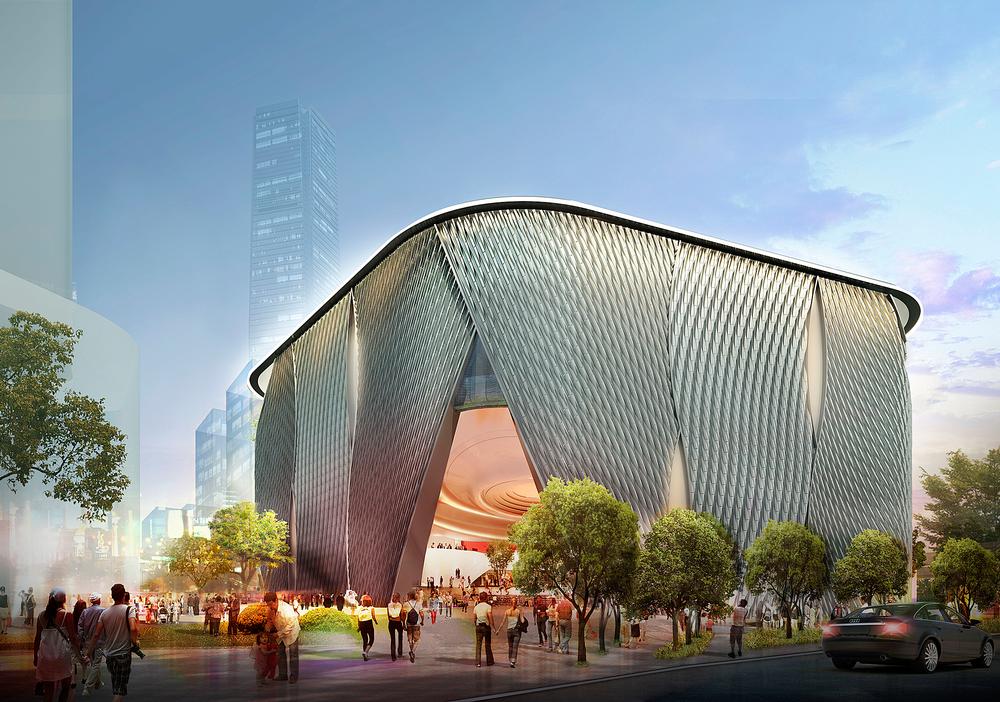
Not far from M+, West Kowloon’s flagship Chinese opera house, the Xiqu Centre, will be designed by Canadian architect Bing Thom, who is known for his work on ethereal civic structures like the Arena Stage in Washington, DC and the Surrey City Centre Library in British Columbia. Thom proposed a jewel box structure with a façade of metal fins that bring to mind theatre curtains; inside, public space on the ground floor leads to an upper-level bamboo garden, teahouse and a main stage built specifically for Chinese opera, which calls for a less steeply inclined viewing angle than Western theatre in order to avoid a foreshortening effect that diminishes the exaggerated movements and elaborate makeup of performers.
“This art form is hundreds of years old but there are no contemporary Xiqu theatres,” says Thom. “We’re going into unknown territories. That’s where real innovation can occur.” In keeping with the philosophy behind Foster’s master plan, Thom wants his building to be as permeable as possible: “We want to build a situation where all the circulation is visible,” he says. The building’s curtain-like façade is marked by distinctly yonic openings, which give the building a certain shimmering transparency. “Even though it’s not physically moving, the quality of light [against the façade] the seasonal changes and the changing of the gardens with different colours will give the building a moving quality,” says Thom.
OPEN SPACE
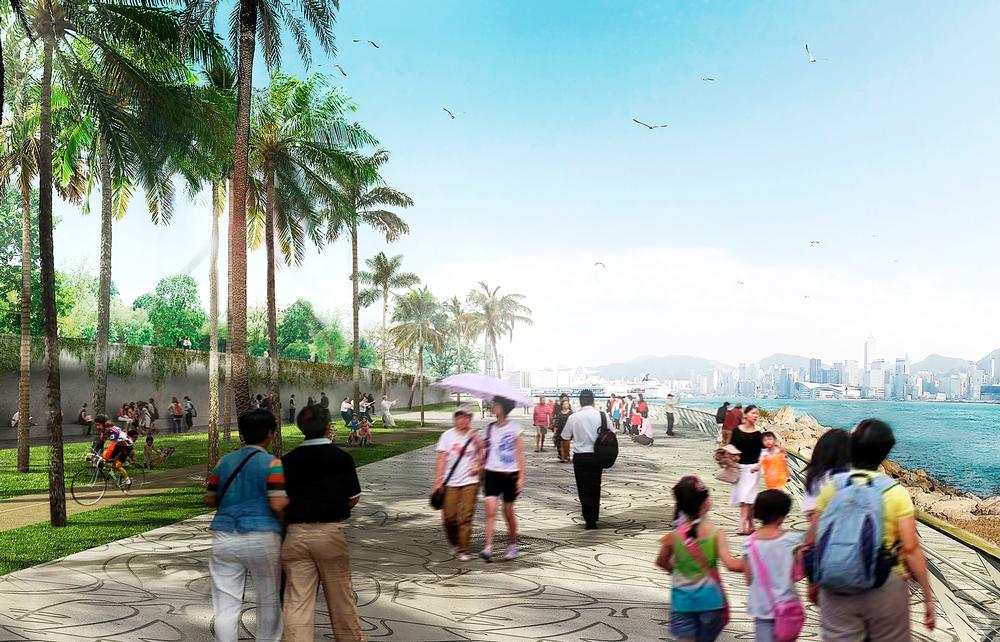
If all goes well, M+ and the Xiqu Centre will open in 2017. That year will also mark the completion of another district landmark: the public park, where Freespace is held each year. When the festival held its first edition in 2012, West Kowloon Cultural District Authority CEO Michael Lynch – the man who oversaw the Southbank Centre’s renaissance in the early 2000s – suggested its freewheeling atmosphere was a preview of the atmosphere in the future park.
“People were doing extraordinary stuff all over the place,” Lynch said at the time. “It had a feeling that people had not been given this opportunity before. It felt like a microcosm of what you'd like the place to be like in 10 years’ time.”
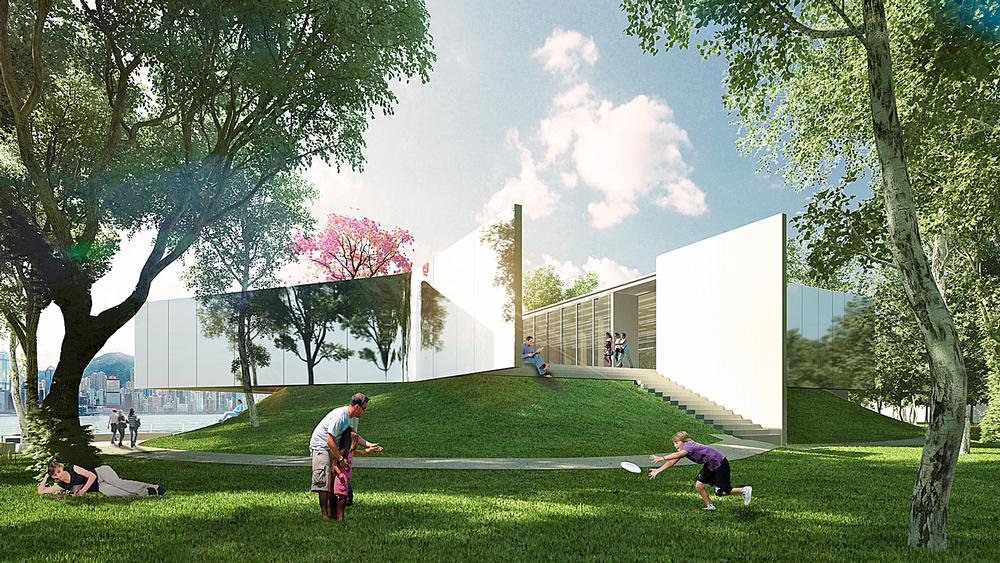
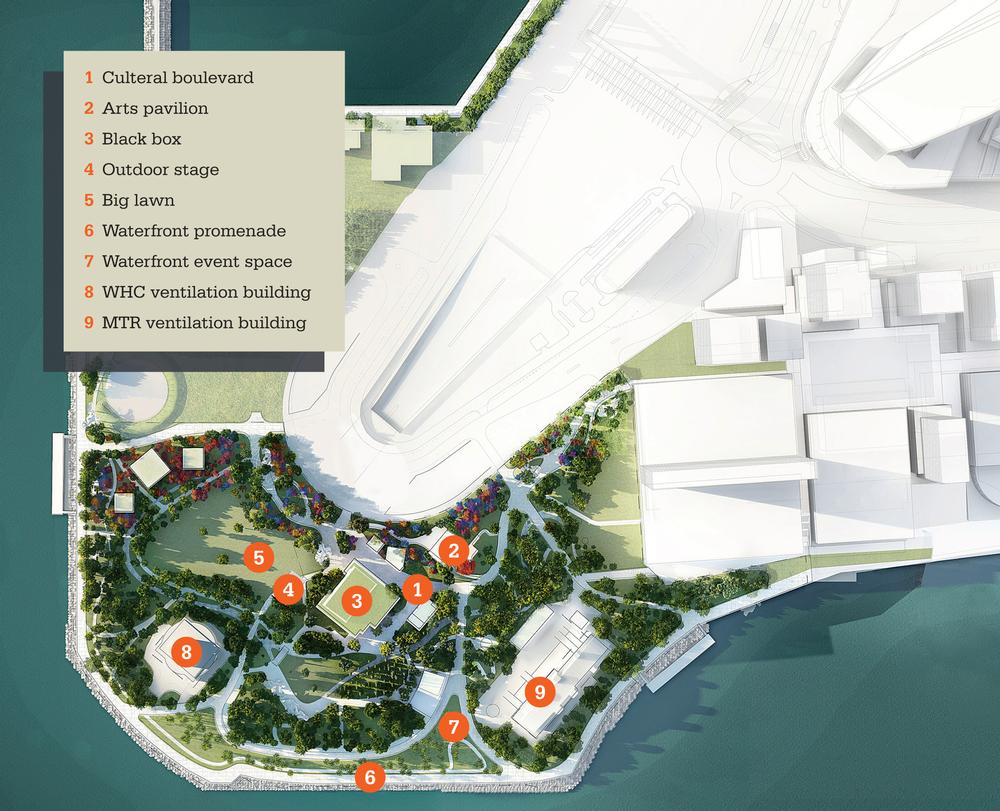
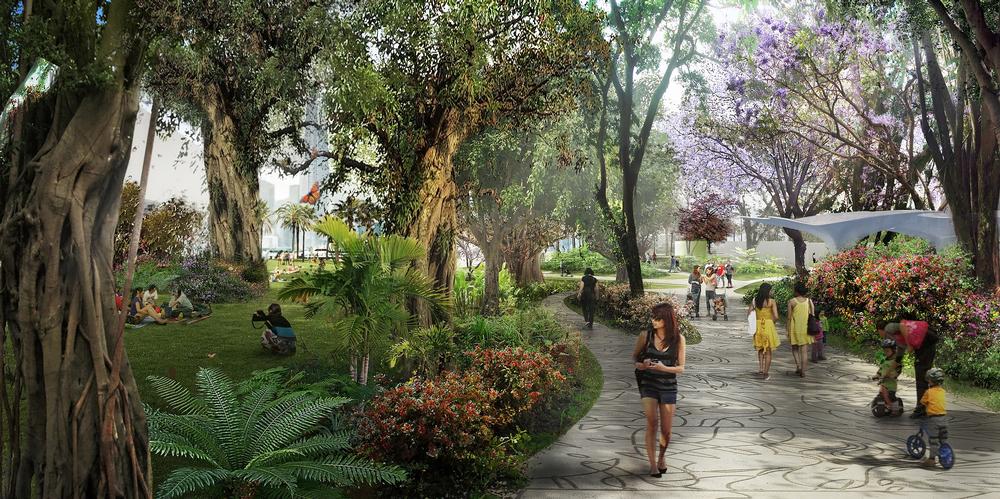
Construction on the park is now underway, with a design by two local firms – Dennis Lau & Ng Chun Man Architects & Engineers, and ACLA – in collaboration with Dutch architects West 8, who were responsible for the revitalisation of Madrid’s riverfront. When it was unveiled last year, the new design sparked controversy for doing away with the lush urban forest proposed in Foster’s masterplan; instead, it features a number of large open spaces and cultural pavilions.
Some decried this as a cost-cutting measure (it cut the park’s budget by half) but others say it reflects the cultural district’s need for flexible space. Mike Hill, director of independent music festival Clockenflap, which last year drew 45,000 people to the site, says the new plan reflects input from festival organisers who wanted more open space to stage events.
John Batten says it is crucial that the public feels the park hasn’t been given over entirely to festival organisers and other event promoters. “The park is the make or break of the project, because the whole plan was sold to the public on the park,” he says. He worries there will be a conflict between active users attending events like Clockenflap and passive users looking for a space to relax. Hong Kong’s fickle weather doesn’t help.
While the public may have high expectations for the park, it’s the cultural district’s urban fabric that may be most important to the district’s long-term success. “This is where the vibrancy comes from,” says Batten. Despite Foster’s vision of lively streets, however, there has been no public discussion on the design of the smaller buildings and public spaces that will comprise the bulk of the district. And with delays mounting, it may be a long while before those urban spaces come to life.








Designed to restore neglected land and renew the identity of Iraq’s capital city, Baghdad Sustainable Forests promises a new way of living surrounded by nature. Gensler’s Ian Mulcahay tells us why he thinks the project could become a model for the repair and enhancement of urban centres